Hello. If you have been putting off selling online because the idea of building a website feels like too much, good news: you do not need one. Instagram has quietly become a full shopping destination on its own. The platform counts 2 billion daily active users according to Meta (July 2026), and many of them use it to discover new products. That is not a niche behaviour anymore: some of those users go on to buy. That is a market.
Set Up Your Instagram Shop the Right Way
Before you tag a single product, you need to get the foundations right. Here is what Meta actually requires to unlock Shopping features:
- A professional account. Personal accounts do not have access to Shopping. Switch yours in Settings.
- A connected Facebook Business Page. Instagram Shopping runs on Meta's commerce infrastructure, so the two accounts need to be linked.
- A valid business status. In France, an auto-entrepreneur registration with a SIRET number is the minimum. Meta will verify this, and validation usually takes a few days.
Once those boxes are ticked, you create a product catalogue inside Meta's Commerce Manager. The good news: all of this is completely free. No subscription, no commission on sales (unlike marketplaces such as Amazon or eBay, which take a commission on every sale), just a one-time setup process.
If you already sell through Shopify, WooCommerce or PrestaShop, you can sync your catalogue automatically via Meta's Commerce API, so you never have to update two places at once.
Which Products Actually Sell on Instagram
Not every product is a good fit here, and being honest about that saves you a lot of wasted effort. The sweet spot is visual products that catch the eye in photos and videos.
Categories that consistently perform well include jewellery, fashion, beauty, home decor, artisan food products and handmade items. If you are a ceramicist, a leather craftsperson, a florist or a skincare brand, Instagram was basically built for you.
On the other hand, complex B2B services, highly technical products or anything that requires a long explanation before purchase tend to struggle. The platform rewards things you can fall in love with at a glance.
The Content Strategy That Actually Drives Sales
Getting your shop set up is step one. Getting people to buy from it is a different challenge, and it comes down to what you post and how often.
In 2026, bet on Reels: they are the format Instagram mostly shows to people who do not follow you yet, which is how you grow your organic reach. Hook people from the first seconds: a Reel that grabs attention early is easier to watch to the end, and watch time is part of what Instagram looks at, according to Adam Mosseri (September 2026). That is precious when you present a product.
A few things that make a real difference:
- Tag your products in every Reel and post. That way, an interested customer finds the product in a single tap.
- Post as much as you can without burning out, as Adam Mosseri advises (September 2026). Stories count too, and they are quick to create.
- Use 3 to 5 tightly focused hashtags. Instagram limits each post to 5 hashtags, caption and comments included, so the old habit of stacking long lists is over. One hashtag for your exact niche, one for your community, one geographic if relevant. That is enough.
- Reply to DMs within 2 hours. For personalised or made-to-order products especially, the conversation in Direct Messages is often where the sale actually happens.
To track your engagement, check the engagement rate of each post in your insights (the share of people reached who reacted) and compare it month to month. If it stays low, growing your follower count will not fix your sales problem. Better content will.
Save Time Without Sacrificing Consistency
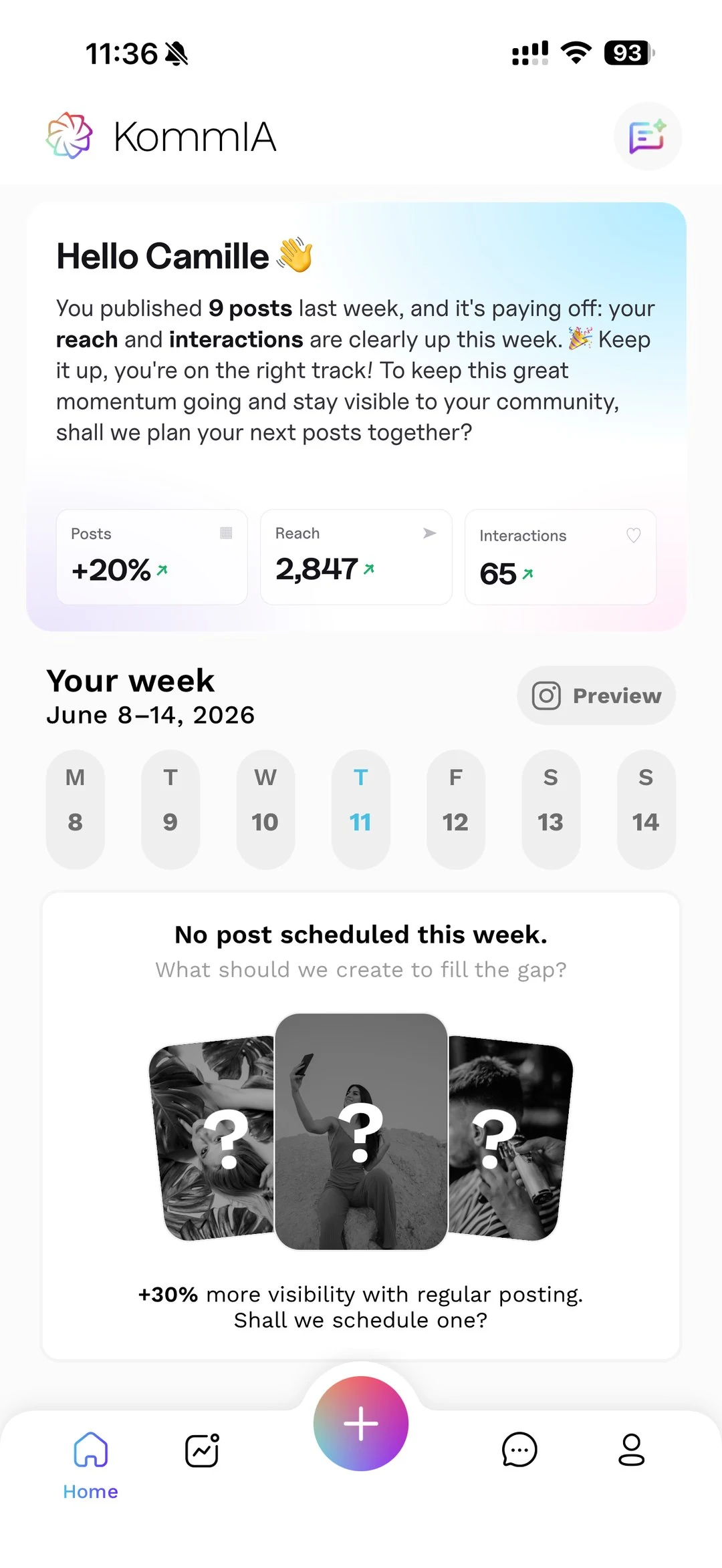
Posting regularly while running an actual business is where most people fall off. The content calendar becomes a second job. That is exactly the problem KommIA was built to solve. KommIA publishes your posts automatically at the time you pick, or at one of the three slots it suggests based on your account's activity, without you having to watch the clock or interrupt your workday to hit publish.
Consistency matters more than perfection on Instagram. An account that shows up reliably, even with simple content, will outperform one that posts brilliantly once in a while. Automating the scheduling part removes the friction that makes consistency hard.
Go Further With Paid Promotion (When You Are Ready)
Organic reach will take you a long way, but if you want to accelerate, Instagram ads are worth understanding. The return depends a lot on your product and your ad, so measure it against your own sales before you raise the budget.
A practical starting point: 10 to 20€ per day for two weeks, testing one audience at a time. Do not run several campaigns at once before you know what works. Start with a single Reel that already performed well organically, boost it to a lookalike audience, and see what the numbers tell you.
Also worth knowing: if you sell items that need a demonstration, a live video lets you show them and answer your customers' questions in real time. It is not essential from day one, but as you grow, it can become a genuine conversion tool.
If you are curious about what it costs to have all of this managed more efficiently, take a look at KommIA's pricing. For most freelancers and small businesses, the time saved quickly makes up for it. You already have the products and the skills. Instagram, set up properly, gives you the storefront. KommIA handles the publishing so you can focus on the work itself.