Why 30 minutes is enough (and why you're not managing it yet)
Your customers are on Instagram, and they spend a lot of time there: people in France spend more than 12 hours a week on social media on average, and Instagram alone takes up more than an hour of it every day. They're not just killing time either: 83% of users say they discover products and services there, and 7 in 10 shoppers check Instagram when they're getting ready to buy. Your account is a shop window your future customers look at before they choose you.
The problem was never your motivation, or even your time. It's the lack of a system. Without a system, every post starts from scratch: finding the idea, second-guessing it, writing, picking the photo, posting at the wrong time, forgetting the following week.
With a system, the decisions are made once and for all, and all that's left is doing the work. This guide gives you that system: one 30-minute session a week, timed task by task, and a daily habit.
And here's the good news: modest consistency wins. 2026 studies agree on 3 to 5 posts a week as the effective range for reach, and Adam Mosseri, the head of Instagram, simply recommends a few posts a week and a few stories a day.
Three good posts a week, kept up all year, beat ten posts in one month followed by nothing.
The principle: 5 tasks, one weekly appointment
Your Instagram comes down to 5 tasks. The first one is set up once, the next three live in your weekly session, and the last one is a daily habit.
| Task | When | How long |
|---|---|---|
| 1. Your brand: who you are, who you're talking to, what people should feel | Once, then a tweak every quarter | 1 hour, once |
| 2. The week's ideas | Weekly session | 8 minutes |
| 3. Creating and scheduling | Weekly session | 17 minutes |
| 4. Reading the numbers | Weekly session | 5 minutes |
| 5. Replying to messages and comments | Every day | 2 minutes, morning and evening |
A word on task 1, the foundation: before your first session, write down your answers to three questions. Who am I, and what makes me different? Who am I talking to, which specific customer? What do I want them to feel and do when they see my account? One page is enough, and everything else builds on it.
The weekly session takes 30 minutes. Pick its time slot now, put it in your calendar like a client appointment, and don't move it again: it's the appointment that works for you all week long.
The 30-minute session, minute by minute
Minutes 0 to 8: pick the week's 3 posts
Don't hunt for ideas out of thin air, pick them from families. There are 6, and together they cover everything a business account needs to show:
- Behind the scenes: your day-to-day, your premises or workspace, your hands at work. Generic example: what your customers never see, the preparation behind a service.
- Know-how: a tip, an answer to a question you get asked all the time. Example: “the mistake I see all the time, and how to avoid it.”
- Proof: a result, a before and after, customer feedback. Example: a testimonial from a happy customer, with their permission.
- Human: you, your journey, what drives you. Example: why you chose this line of work.
- Offer: something new, your availability, a key period. Example: the slots opening up for the season.
- Interaction: a question for your community, a poll. Example: “Which do you prefer, A or B?”
The rule for the week: 3 posts, 3 different families, and the Offer family no more than every other week. An account that only sells wears people out; an account that shows, teaches and involves them makes them want to come back. Write down your 3 picks in one line each, no more (the family, then the idea in five words), and move on.
The trap in these 8 minutes: wanting the perfect idea. An average idea that gets posted beats a perfect idea that stays in your head.
Minutes 8 to 25: create and schedule the 3 posts in one go
Creating in batches is where most of the time savings come from: you stay in the same frame of mind, with the same photos at hand, and you don't reopen the app three times during the week.
Photos first
Your real photos, taken during the week, beat any generic image: your business, your hands at work, your craft are what people want to see.
A pro tip: photograph the action as it happens, not the frozen result. A hand at work or a material being poured catches the eye more than the product sitting neatly in the middle of the frame.
Photograph your day-to-day as you go, and your camera roll becomes your content bank.
Then the caption
A simple structure is enough: a first sentence that makes people want to read on, the substance of the idea, and a call to action (reply, comment, come by, book).
The detail that matters is that first line: it has to create tension, not announce the topic. “Here are my 3 signature treatments” puts people to sleep; “The treatment I tell 8 out of 10 clients not to get” stops the scroll.
Time yourself: 5 minutes per caption at most.
The format
When you have several images that tell a story together, go for a carousel: Adam Mosseri has confirmed publicly that carousels get more reach on average than single photos.
Watch your second slide as closely as the cover: if it doesn't deliver on the promise from the very first second, people drop off, so never put filler on slide 2.
And think about shares: being sent in direct messages has become one of the strongest signals for Instagram to show your post to new people. A useful post, one your customer wants to send to someone, works for you.
Scheduling to finish
The 3 posts go out on different days.
As for the time of day, don't trust the internet's “best times to post”: in your audience insights, Instagram shows you when your own followers are active, so post just before that peak.
Schedule, don't post by hand: scheduling is what makes consistency painless.
Add a few stories a day when it feels natural (a behind-the-scenes moment, a poll, the day's post reshared): that's the frequency Instagram recommends, and stories keep the connection going with the people who already follow you.
Minutes 25 to 30: read 3 numbers, ignore the rest
Instagram's insights swamp beginners. Each week, look at these three numbers only:
- Reach: how many people saw your posts. It tells you whether your shop window is getting bigger or not.
- Interactions (shares and saves above all): the sign that your content is worth something to someone, and shares are one of the strongest signals for being shown to new people.
- Messages and profile visits: this is intent. Someone who visits your profile or writes to you is a potential customer coming closer.
The question to ask yourself in those 5 minutes: which of my 3 posts worked best, and what will I do again next week in the same family?
The 2-minute habit, morning and evening: messages bring in customers
This is the task everyone neglects, and it's the one most directly tied to your revenue. Every month, 150 million people start a conversation with a business on Instagram, and a direct message is often the first reflex for asking about a price, a time slot or a detail. Expectations are high: nearly 3 in 4 consumers expect a reply within 24 hours.
The habit: morning and evening, for 2 minutes, you open your messages and comments and reply to everything, even briefly. Two details change the outcome:
- Don't just reply, steer toward action: when someone asks “how much is it?”, end with an open door, “want me to hold a slot for you this week?”
- In the evening, reshare the day's post in your story, but don't just copy it as is: hide part of it to spark curiosity, add a hook or a poll sticker, give people a real reason to go and look.
A quick, warm reply does more for your reputation than the most beautiful post.
Let's be honest: the plan is simple, execution is where you hit the wall
You now have the complete system. And if you're honest with yourself, you already know where it will get stuck: the Tuesday evening when the idea won't come, the caption that takes 20 minutes instead of 5, the busy week when the session gets skipped.
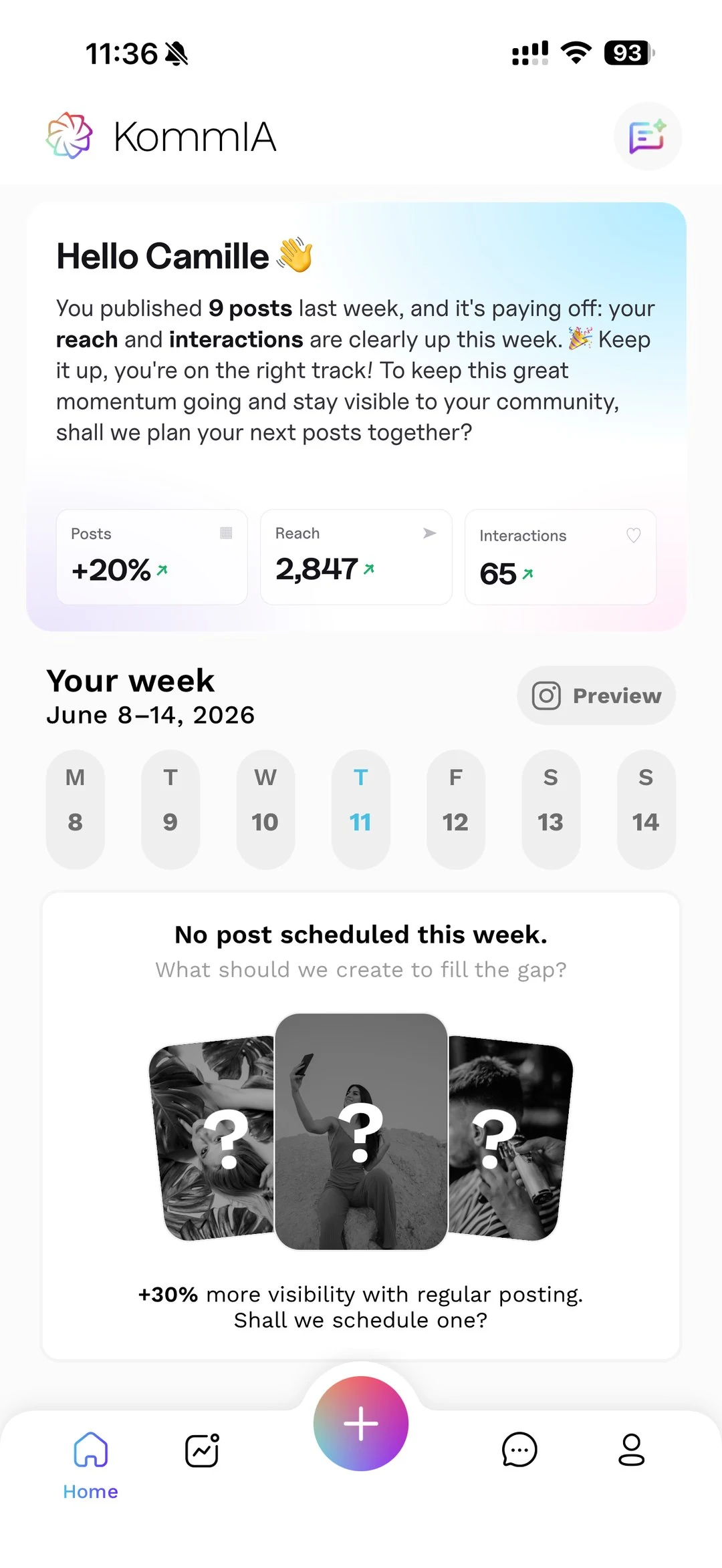
Sticking to this plan by hand takes real discipline. That's exactly where artificial intelligence becomes useful for independent professionals: ideas already tailored to your business, captions written in your tone of voice, your photos enhanced without distorting them, scheduling and suggested replies all in one place. The 30-minute session becomes doable because every task in the plan gets a helping hand.
Your weekly planner, ready to print
Print the one-page planner and put it up where you work: your 30-minute session, the 6 idea families and your 3 numbers all fit on it.
See the printable planner