
Hello. You spent time on a post, you hit publish, and then... nothing. A handful of likes, mostly from people who already follow you, and a reach that looks almost embarrassingly low. You are not imagining things. According to Socialinsider (June 2026), even a Reel reaches on average only 9.78% of followers on an account of 1,000 to 5,000 followers, and 5% on an account of 100,000 to one million. If you are a freelancer, artisan or small business owner, that is a real problem, because every post costs you time you don't have to waste.
Each Format Has Its Own Distribution
The first thing to understand is that Instagram does not show all your formats to the same people. Feed, Reels, Stories, Explore and Search each work differently, and your content can perform very differently across these surfaces. A post that flops in the Feed might still reach new people through Explore, or travel fast through Reels. This means blaming “the algorithm” as one big mysterious force is no longer the right mental model.
What Instagram's head Adam Mosseri said again in May 2026 is that the platform looks at three signals, always measured against the number of people reached: watch time, shares in DMs, and likes per reach. Saves and comments count too, but they are not part of these three signals. Shares in DMs weigh most for reaching people who do not follow you yet, and likes mostly with your followers. In other words, Instagram judges your posts on these signals rather than on your follower count.
The Formats That Actually Get Seen
Not all formats are equal, and the gap in 2026 is significant. Here is what the data shows:
- Carousels reach 8.80% of followers on average on an account of 1,000 to 5,000 followers, and beyond 100,000 followers they are the format that reaches the most followers (Socialinsider, June 2026). They also hold the highest engagement rate at 0.50% in the second quarter of 2026, according to Socialinsider. And they encourage saves, which count too.
- Reels reach 9.78% of followers on an account of 1,000 to 5,000 followers, the best score of the three formats (Socialinsider, June 2026), with an engagement rate of 0.48% in the second quarter of 2026.
- Single photos reach about 7% of followers on average on an account of 1,000 to 5,000 followers (Socialinsider, June 2026), with an engagement rate of 0.33% in the second quarter of 2026. If you are still relying mainly on single images, that is likely your biggest problem.
- Stories are shown only to your followers, according to Adam Mosseri (April 2026). They are still useful for keeping your existing audience warm, but they won't bring you new eyes.
According to Metricool (June 2026), a Reel generates more than four times the interactions of a single photo, and single photos lost nearly 22% of their reach in a year. That is not a small difference. If you have been avoiding short video because it feels complicated, it is worth reconsidering.
Keywords Beat Hashtags Now
Another change that catches many small business owners off guard: hashtags have stopped being the discovery engine they once were. In 2026, Instagram's system works much more like search. Keywords in your captions and on your profile are now what drives discoverability. If you run a ceramics studio in Lyon, writing “handmade ceramic bowls, Lyon” directly into your caption will do more for your reach than a cluster of hashtag variations.
In June 2026, Instagram also rolled out its “Your Algorithm” feature to the main Feed, after Reels and Explore. It lets users filter certain types of content themselves from their settings. This means that if your account jumps between food photography on Monday and business tips on Thursday, some of your followers may simply stop seeing you. Staying consistent within a niche protects your distribution.
Timing and Consistency Still Matter
Instagram uses an “audition” system for new posts: your content is first shown to a small group of people. If that group engages, the platform expands distribution to a larger group, and so on. This is actually good news for small accounts, because it means going viral is still possible without a large following. But it also means that posting at the wrong time, when your specific audience is not active, will waste that first critical window.
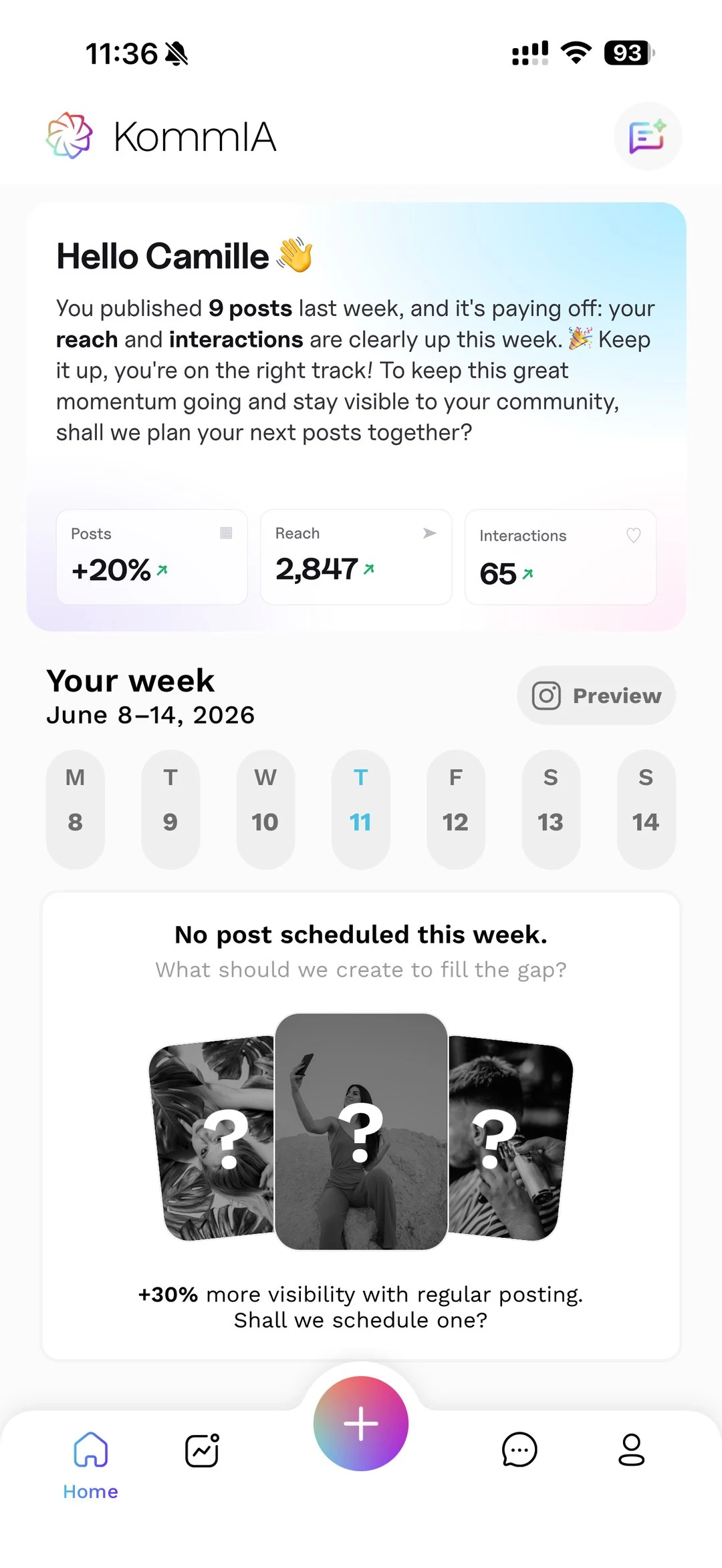
This is exactly why KommIA suggests three time slots based on your account's activity, each with its reason, so you can pick a good time without having to track analytics or guess. You take the photos, and KommIA prepares the ideas, captions and hashtags, then publishes at the time you pick, so you can focus on running your business. Check the KommIA pricing page to see whether the monthly or the annual plan fits your needs.
Also worth testing: Instagram's Trial Reels feature, which lets you publish a Reel to non-followers only before releasing it to your full audience. If it performs well in the trial, you push it out broadly. If it doesn't land, you haven't damaged your engagement rate with your existing community.
What to Change Starting This Week
You don't need to overhaul everything at once. A few focused adjustments will already make a measurable difference:
- Add at least one carousel or Reel a week, even a simple one filmed on your phone.
- Write captions that include the actual words your audience would search for, not just hashtags.
- Ask yourself whether each post gives someone a reason to save it or share it in a DM. If the answer is no, rework the content before publishing.
- Stay consistent within your topic area so that Instagram's system can classify your account clearly and show it to the right people.
- Use a scheduling tool like KommIA to publish at the time you pick, or at one of the three slots it suggests based on your account's activity, without you having to watch the clock.
Reach has dropped across the board, but the accounts that understand the current signals and adapt their format and content strategy are still seeing solid results. The window is open, you just need to step through it differently than you did two years ago.