
Hello! If you have ever stared at a blank Instagram grid wondering whether you are posting too little, too much, or at completely the wrong times, you are not alone. For freelancers, artisans and small business owners, Instagram can feel like a full-time job on top of the actual full-time job. So let's cut straight to what the numbers say in 2026, and what that actually means for your weekly routine.
The Honest Answer: A Pace You Can Keep Up
No recent study links the number of posts to account growth: according to Adam Mosseri (September 2026), the best approach is to post as much as you can, at a pace you can keep up, and to test. Freshness counts, since more than half of the content recommended in the feed is less than a day old according to Meta (July 2026), but posting more and more has a cost: without a dedicated content team behind you, it is often the quality of each post, and your energy, that suffer.
For small businesses and solo operators with limited time, 2 to 3 solid posts per week is a completely realistic baseline. It is enough to keep your account active and stay in your customers' minds without exhausting yourself over the months.
One thing worth remembering: even 2 or 3 genuinely strong posts each week, combined with daily replies to comments and messages, can outperform an account that publishes every single day but phones it in.
Format by Format: What to Aim For
Instagram does not treat every format the same way. Your Stories are mostly seen by your followers, while your Reels can be recommended to people who do not follow you yet. That means the right pace actually depends on which format you are using.
- Feed posts and carousels: a really well-made educational carousel can outperform an average Reel, so do not drop them.
- Reels: still the main discovery format in 2026, showing your content to people who do not follow you yet through Explore and recommendations. For a small account, they also reach the largest share of followers: according to Socialinsider (June 2026), a Reel reaches an average of 9.78% of followers on an account with 1,000 to 5,000 followers, against 8.80% for a carousel and 7% for a photo.
- Stories: no number to aim for. They are ephemeral, so they work differently from feed posts: post some when you have something to show. Regular Stories keep the conversation going with your followers, which also helps your feed posts stay on their radar, so even quick behind-the-scenes clips are worth the effort.
- Lives: only now and then. They require real preparation and your audience's undivided attention.
For Reels specifically, open with a strong hook in the first 3 seconds, and aim for a loop that makes people want to watch again. The right length depends on your content, but the hook always has to land right at the start. Short, punchy and purposeful.
What Actually Moves the Needle in 2026
Instagram looks at watch time, likes and sends in private messages, always measured against the number of people reached: likes weigh most with your followers, sends most for reaching new people, according to Adam Mosseri (May 2026). When someone sends your post to a friend, that tells the algorithm there is a real connection happening. When someone saves a carousel for later, it signals that the content had genuine value. The raw number of likes is no longer the key indicator.
That shift changes how you should think about content. A beautifully shot product photo with zero shares will underperform a scrappy but genuinely useful tutorial that people bookmark and forward. Aim to make something worth saving or sending.
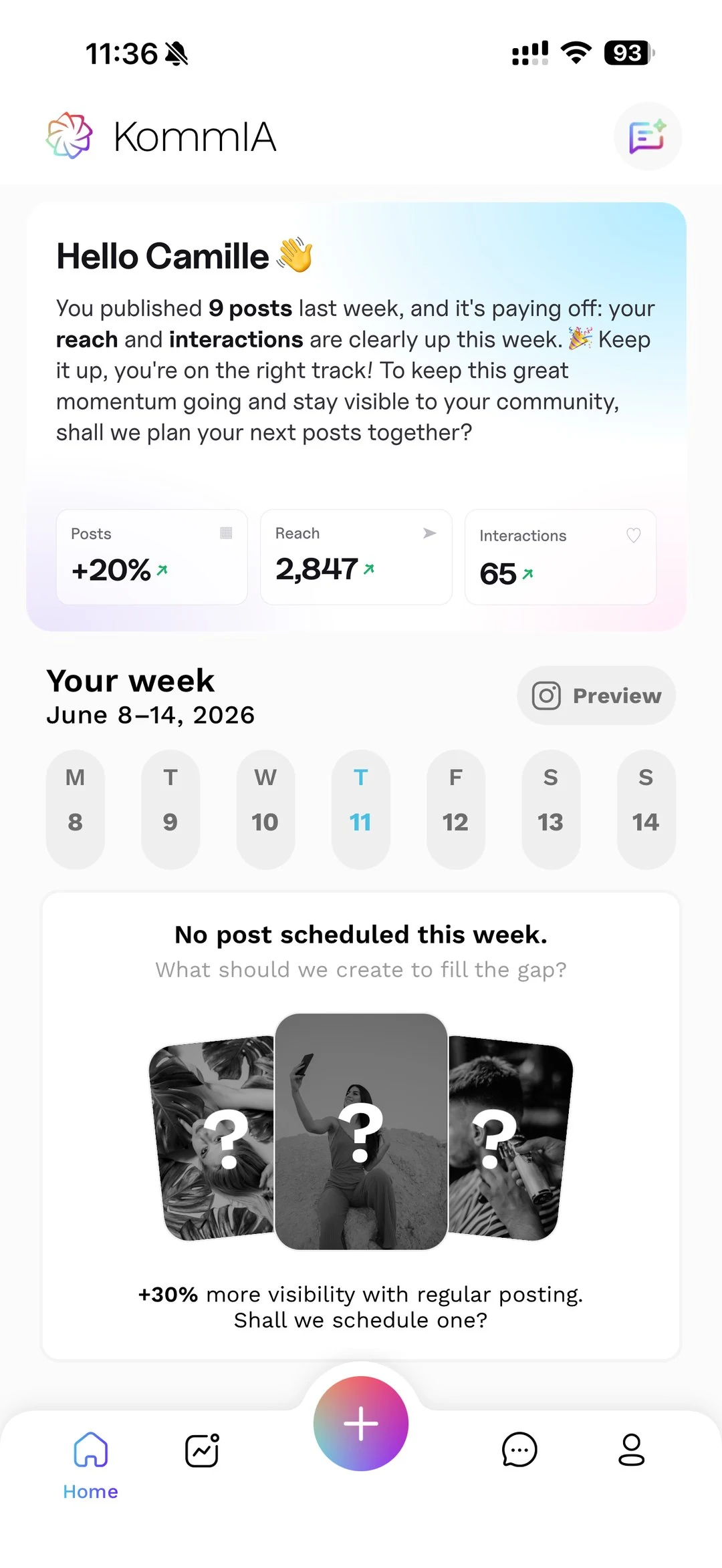
There is also one myth worth putting to rest: posting at a very specific time of day matters far less than the content itself. Publishing at 7:02 pm instead of 2:00 pm will not rescue a post that fails to hold attention. No single time works for everyone, so pick a time when you can reply to comments. That is why KommIA suggests three time slots based on your account's activity and publishes at the one you pick, so you do not have to keep track of it yourself.
The Trap of Doing Too Much
One of the most common mistakes small accounts make is trying to use every single Instagram feature at once. Stories, Reels, carousels, Lives, broadcast channels, all simultaneously. It is better to pick a few formats and use them consistently well than to scatter your energy across everything.
Over-posting carries a real risk too. When the quality of each post slips, your engagement rate drops: fewer of the people who see your posts react, and since Instagram reads reactions as a rate per person reached, your content ends up shown to fewer people.
The other thing to avoid: recycling content from other platforms. TikTok videos with a watermark, YouTube thumbnails repurposed as feed posts. Take the time to make a clean version for Instagram: every post deserves to be native.
Building a Routine You Can Actually Keep
There is no clever trick here. What works is a pace you can keep, week after week, for a long time. An ambitious schedule you drop after six weeks is worth far less than a modest schedule you can keep up for six months.
A practical starting point for most freelancers and artisans looks like this:
- 2 Reels per week, each with a strong opening hook and genuine usefulness or entertainment value.
- Carousels or feed posts sharing something from your craft, your process or your expertise.
- A few Stories when you have something to show, even just a quick photo or a poll.
- Replies to every comment soon after posting, because comments are among the reactions Instagram takes into account.
That is a pace you can keep up alongside an actual job.
To make this even easier, KommIA suggests the post ideas, writes the captions and publishes at the times you pick, so you batch your content creation once and keep that pace. If you want to see how it fits your budget, take a look at the pricing options here. The goal is simple: spend less time managing Instagram, and more time doing the work you actually love.