
Hello. If you run a small business, a craft studio, or a freelance practice, you already know the feeling: Instagram takes time you do not really have. Writing captions, finding ideas, deciding when to post, checking what worked. It piles up fast. The good news is that AI tools can now absorb a big chunk of that workload. The uncomfortable question, though, is whether using them means your account starts to feel like a robot wrote it. Let's be honest about what AI should do, what it should never do, and how to keep both your sanity and your credibility on the platform.
What the Numbers Actually Tell Us in 2026
Instagram now has 2 billion daily active users, according to Meta (July 2026). That is a lot of noise to cut through. At the same time, AI is already part of the daily routine for creators and marketers, especially to save time on content creation. Among French small businesses specifically, adoption has clearly grown in twelve months: according to the France Num 2026 barometer, 40% of French small and medium businesses use at least one AI solution, up from 26% a year earlier.
On the practical side, AI tools save you real time on social media management. For a freelancer or artisan who bills by the day or by the job, that is worth taking seriously.
What Instagram's Algorithm Actually Rewards Right Now
Here is where things get interesting, and a little paradoxical. In April 2026, Instagram announced a significant shift in its algorithm to favour original creators over accounts that recycle content. Adam Mosseri confirmed in May 2026 that three signals count the most in ranking: watch time, likes and sends by direct message, each measured per person reached. He said it again in September 2026: originality is one of the ranking principles, and the original creator comes before those who repost their content.
Likes weigh mostly with your followers, while shares sent via direct message weigh mostly when it comes to reaching people who do not follow you yet. When someone sends your post to a friend, it means they found it useful or funny enough to recommend. For Reels, watch time is critical: keep them under 90 seconds and open with a strong hook in the first three seconds.
Instagram also stops recommending an account to people who do not follow it when it mostly reposts other people's content without adding anything, and since 31 August 2026, a profile that shows an AI-generated person without disclosing it loses its recommendations. Using AI as a tool needs no label. So the strategy is not “use AI to post more content faster.” The strategy is “use AI to do the invisible work, so your visible content feels more human, not less.”
The Right Jobs for AI (and the Wrong Ones)
Think of AI as a very capable assistant who is great at preparation but should never represent you in a conversation. Here is how that breaks down in practice.
Good uses for AI on Instagram:
- Brainstorming a content calendar for the coming month based on your services and seasonal moments
- Drafting a few caption variants so you can pick the one that sounds most like you, then edit it
- Generating visual concepts or producing several image variations to choose from
- Analysing which posts got the most saves, shares, or comments, and spotting patterns
- Writing your captions with Instagram SEO in mind, so the platform's search feature can surface your content to the right people
What you should keep fully human:
- Replying to comments and DMs (your audience can tell the difference)
- Deciding your editorial line and what you actually stand for
- Sharing personal stories, behind-the-scenes moments, or your actual opinion on something
- Showing your face, your hands, your workspace
The rule is simple: automate the publication and the reporting, keep the human in the conversation and the creative direction.
A Sustainable Rhythm for Small Structures
You do not need to post every day. Adam Mosseri advises posting as much as you can, at a pace you can keep up (September 2026), and no recent study sets a number of posts per week. Add Stories almost every day: that is a more durable rhythm than a daily flood of low-effort content. Mixing formats helps too: alternate between Reels, carousels, Stories, and occasional Lives.
Carousels work particularly well for freelancers and artisans because you can package your expertise into something memorable: a checklist, a before-and-after, a tutorial sequence. Write the captions the way a potential customer would search for what you do.
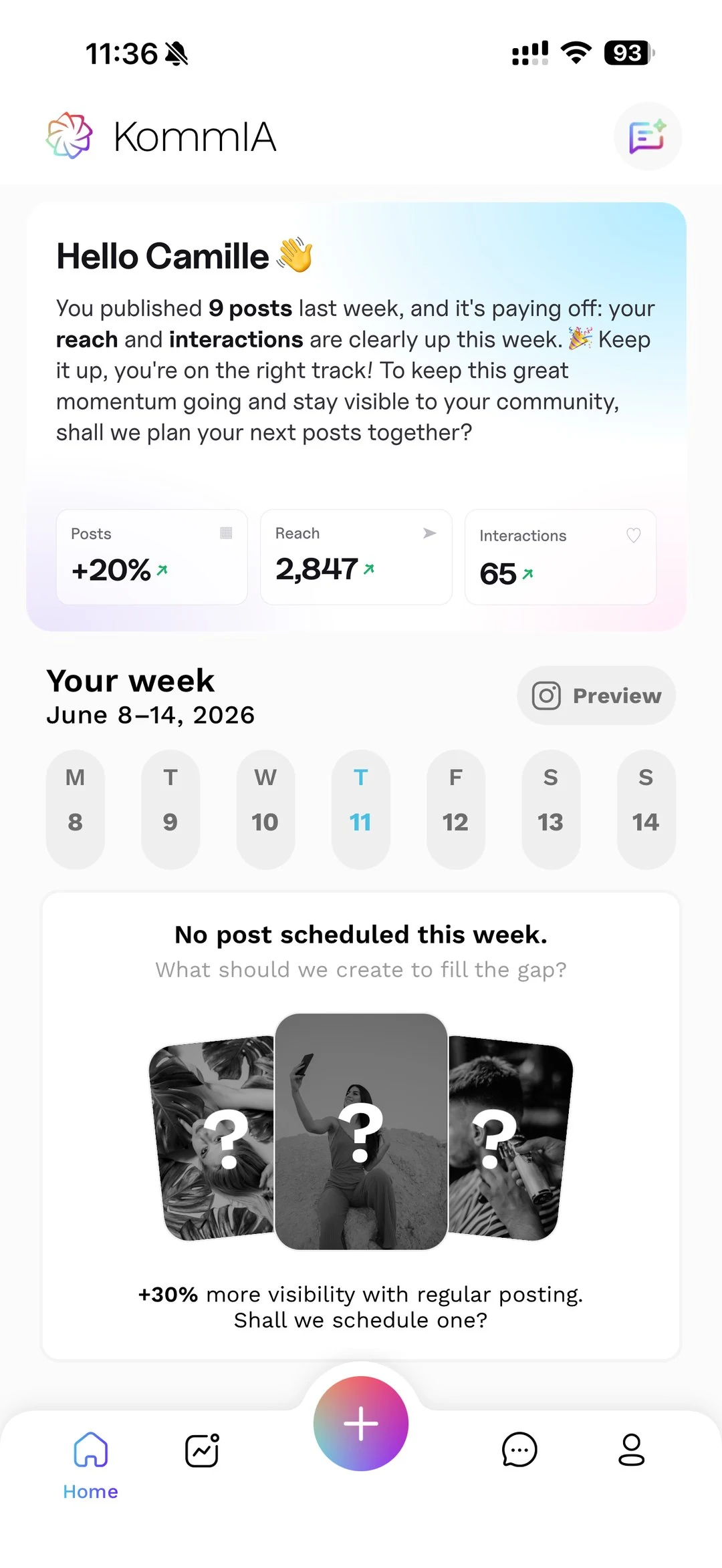
As for timing, there is no universal best hour. Your audience is yours alone, so use Instagram Insights to find when your specific followers are actually online. This is exactly where a tool like KommIA earns its place: it suggests three time slots based on your account's activity, each with its reason, and publishes at the one you pick, so you do not have to work it out manually each time. You take the photos when inspiration strikes, and the tool drafts the caption and hashtags for you to rework and approve.
Keeping It Real While Using the Tech
Put plainly: creators who build trust by being authentic, transparent, and consistent are the ones who stand out. That is not a warning against using AI. It is a description of how to use it well.
Use AI to clear the boring parts of your workflow so you have more mental space for the things only you can do: your story, your craft, your point of view. A carpenter who uses AI to draft three caption ideas and picks the one that sounds like him is still a carpenter with a real voice. The problem only starts when the caption goes out unread and the replies get auto-generated too.
If you are curious about what this looks like in a concrete tool built for people like you, take a look at KommIA's features or check the pricing page to see whether it fits your setup. The goal is always the same: less time on the logistics, more on the work that actually matters.