
You can read just about anything about the Instagram algorithm, and many of the “rules” going around have never been confirmed by anyone. This article only keeps what Instagram and its head, Adam Mosseri, have said publicly since spring 2026, along with the studies published since then. Instagram moves fast, so we update this page as soon as something changes.
What Instagram Really Looks At
To choose what it shows each person, Instagram predicts what that person will do with your post: like it, comment on it, send it to a friend, watch it, watch it to the end. It turns this into a score, post by post, and these predictions are what decide your reach. That is how Adam Mosseri described ranking in his video series of September 2026.
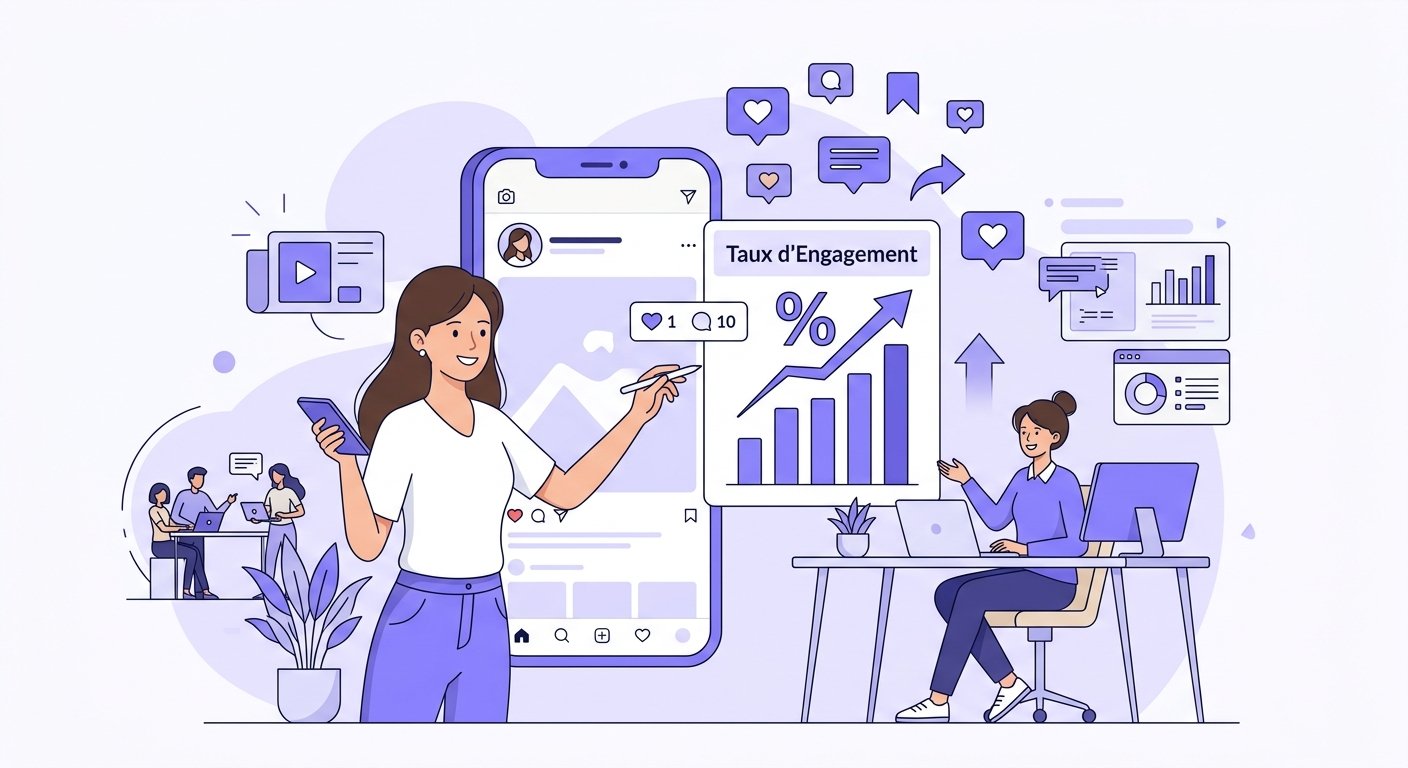
These reactions are read as rates, never as totals. What matters is the share of people reached who liked, commented on, saved or sent your post, not the raw number of views. And likes still count: according to Adam Mosseri (May 2026), the like rate weighs most with your followers, and the rate of DM sends weighs most with people who don't follow you yet.
For a video, watch time remains central: “watch it” and “watch it to the end” are two of the predicted reactions. Saves and comments are part of the engagement rate, but Instagram doesn't rank them above the others. Finally, Instagram doesn't publish any weighting between these reactions: nobody can tell you that one send is worth three likes, or ten.
To hold attention from the very first seconds, we explain how to choose the right length for an Instagram Reel.
Freshness Matters More and More
Recent posts are taking up a growing share. According to Meta (second-quarter results, July 2026), more than half of the content recommended in the feed is less than a day old, a share that has more than doubled in a year. Adam Mosseri also named recency among the principles of ranking in September 2026.
For you, the consequence is simple: a post lives mostly in the hours and days after it goes live. You are better off posting regularly, at a pace you can keep, than preparing one big push every two months.
Originality Is the New Way In
Since April 30, 2026, an account where most of the photos, carousels and Reels posted over the last 30 days are not original is no longer recommended to people who don't follow it. Your followers still see you, and the account becomes eligible again as soon as its recent posts are mostly original again. According to Instagram, 75% of recommendations in the United States now come from original posts (announcement of April 30, 2026).
A watermark, a border, a credit in the caption or a screenshot doesn't make someone else's content original. For an artisan or a shop owner, the risk doesn't come from memes but from easy formats: a customer review posted as a screenshot, a photo sent in by a customer, a visual supplied by a manufacturer. On their own, they cause no problem. If they make up most of your posts over a month, they can take you out of recommendations. Add your voice, your own text or an explanation of how you work, and they become yours.
If you're unsure, open Account Status: Instagram shows there whether your posts can be recommended to non-followers, and you can appeal from there. That is often where a sudden drop in reach gets explained, as we detail in our articles on the Instagram shadowban and on posts that are no longer seen.
Small Accounts Stand a Chance
Good news if you work for yourself: Instagram deliberately tests posts from small creators with people who don't follow them, to see whether they do better than expected. Adam Mosseri presented this in September 2026 as one of the principles of ranking.
The numbers point the same way. According to Socialinsider (June 2026, 140,000 Reels published from January to June), a Reel reaches on average 9.78% of the followers of an account with 1,000 to 5,000 followers, compared with 5% for an account with 100,000 to one million. Collaborations help too: according to an Emplifi study reported by Blog du Modérateur (September 2026), accounts with fewer than 10,000 followers get five times more interactions when they accept a collaboration started by a creator.
What the 2026 Numbers Say About Formats
Each format has its role. In the second quarter of 2026, the carousel was still the most engaging format for business accounts (0.50% of followers), just ahead of the Reel (0.48%) and well ahead of the single photo (0.33%), according to Socialinsider's quarterly benchmark. According to Metricool's study of 24 million posts (June 2026), a Reel generates more than four times the interactions of a single photo, the carousel gets nine times more saves, and the single photo lost nearly 22% of its reach in a year.
On length, among brand Reels published from January to June 2026, those of 30 to 60 seconds reached the largest share of followers, and those of 45 to 60 seconds got the best engagement, according to Socialinsider (June and July 2026). But everything is decided at the start: between 60 and 65% of viewers leave a Reel within the first three seconds.
Remember the split: the carousel for what people want to keep (prices, tips, before and after), the Reel to get discovered. All the details are in our guide to Instagram Reels.
Your Algorithm and the New Tools
Since June 10, 2026, the “Your Algorithm” settings cover all of Instagram, main feed included: anyone can see the topics Instagram associates with them and ask to see more or less of them. This setting belongs to the viewer, not to you, but it favors accounts whose subject is clear at first glance. Spell out your trade on screen and in your captions.
- Your Insights: since April 2026, they show engagement rate, share rate, skip rate and how views change over time. These are the right indicators to follow.
- Google: since July 2026, Google Search Console shows you the searches that lead to your Instagram posts, even if you don't have a website.
- Trial Reels: they show a Reel to non-followers only, and Adam Mosseri recommends them for testing an idea without imposing it on your followers. Since April 2026 you can schedule them, if your account has access.
- AI profiles: since August 31, 2026, a profile that shows an AI-generated person without disclosing it loses its recommendations. Using AI to retouch a photo, write a caption or create a visual doesn't require any label.
- Clickable links: since September 15, 2026, they are possible in posts, but only with a paid Meta subscription, and with no extra reach. The link in your bio and the link in your Stories stay free.
The other changes of the year are gathered in our article on what's new on Instagram in 2026.
What No Longer Works (or Never Did)
- Weightings between signals (“a share is worth five likes”): there is no official source, these are blog estimates.
- Long lists of hashtags: Instagram limits hashtags to 5 per post, caption and comments included. They help categorize your post, they don't give it reach: according to Metricool (June 2026), posts carrying at least one got 31.7% fewer views than average. Our article on Instagram hashtags explains how to choose them well.
- Resharing your post to your Story to revive it: according to Adam Mosseri (April 2026), it doesn't really change its reach, since your Stories are only seen by your followers.
- The best time to post: no study based on 2026 data gives one. Check your Insights to see when your audience is online instead.
- “Instagram detects AI and lowers your reach”: false in general, true only for a profile that shows an AI-generated person without disclosing it.
- The word “shadowban”: Instagram doesn't use it, but losing recommendations is real, it shows up in Account Status and you can appeal it.
In Practice, When You Manage Your Account Alone
The 2026 rules favor what an artisan already does: showing their work. A few habits are enough:
- Post your own photos and videos, and add context to any content that comes from a customer or a supplier.
- Open your Reels with the result, the work in action or the question, never with an introduction.
- Give people a reason to send your post to someone: a useful tip, a before and after, a piece of local news.
- Write your caption like a search page, with your trade and your town spelled out in full, and end with a real question.
- Read your Insights as rates, keeping your followers and everyone else apart.
- Keep a pace you can sustain: Adam Mosseri advises posting as much as you can without burning out, and no recent study sets an ideal number of posts per week.
To go further on interacting with your community, also read our article on Instagram engagement, and the one on Instagram's Explore page.
Don't Spend Your Evenings on It
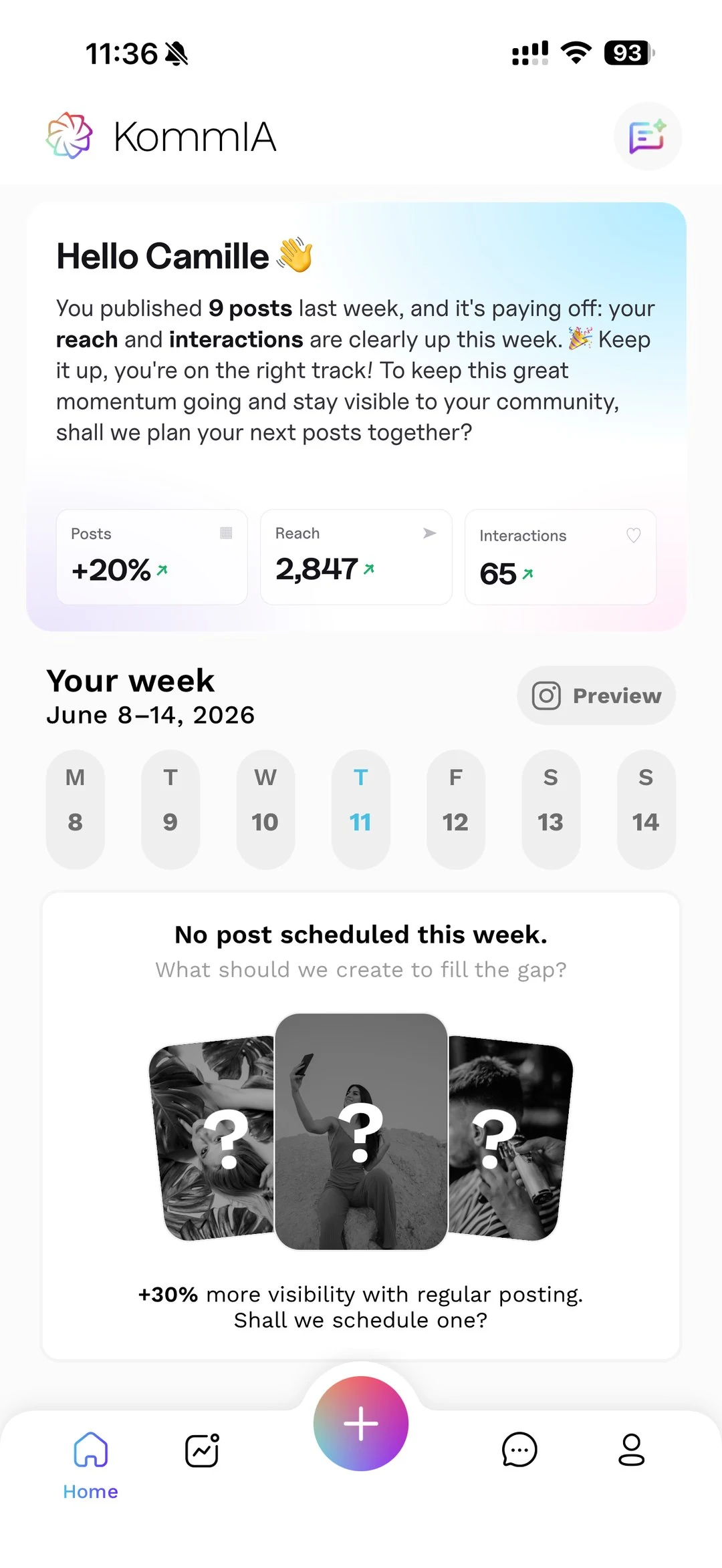
Understanding the algorithm is good. Keeping up the pace without thinking about it every evening is what makes the difference over time. That is where KommIA helps: content ideas tailored to your trade, captions ready for you to approve, and posts published at the times you pick. To see what it costs, the plans are detailed on the pricing page.