
Hello. If you run a restaurant, a food stall, or even a small café, you already know that people check your Instagram before they check your address. In France, NapoleonCat puts Instagram's advertising audience at around 31 million people in September 2026, or 46% of the population. So the question is not whether Instagram matters for your business. The question is how to use it without spending every evening glued to your phone instead of running your kitchen.
Why Instagram Is the Right Place to Focus Your Energy
Many customers look at what a restaurant shows online before going, and Instagram is one of the shop windows they check. Food content suits Instagram particularly well, because it is visual and makes people hungry. It is also everywhere, so the algorithm has plenty to choose from: the hashtag #food alone gathers a huge mass of posts worldwide. Standing out matters. And format counts: according to Socialinsider (June 2026), restaurants and cafés get 0.23% engagement on their Reels, against 0.12% on their single photos. A discovery on Instagram can quickly turn into a booking. That is not a vanity metric. That is a direct line between a photo and a full table.
Your Instagram is not decoration. It is part of your revenue engine.
The Three Formats That Work Right Now
In 2026, growth that actually translates into bookings comes from a consistent mix of three formats. Each one does a different job.
- Reels reach new people. On an account with 1,000 to 5,000 followers, they reach 9.8% of followers on average, against 7% for a single photo, according to Socialinsider (June 2026), and they show you to people who do not know you yet. Keep them under 90 seconds, and open with your strongest visual in the first 3 seconds: cheese pulling apart, a drink being poured, a close-up of a texture. Skip logos and slow intros entirely. Attention is gone before you finish the intro animation.
- Carousels build loyalty. They have the highest engagement rate on the platform according to Socialinsider, 0.50% of followers in the second quarter of 2026, and they get nine times more saves than single photos, according to Metricool's study of early 2026. Instagram can also show them again, on a different slide, to people who scrolled past without stopping. One good carousel can keep collecting views for days.
- Stories convert. They appear at the very top of the app, where your closest followers see them first, even before feed posts. A quick Story on a Tuesday evening, showing tonight's special or a nearly full booking sheet, reminds people they should come in. Replies to Stories are up 88% year on year, according to Metricool's study of early 2026. People are talking back, so use that.
Content Ideas You Can Actually Produce
You do not need a professional video crew. Here are the types of content that perform well for restaurants and are realistic to create between services.
- A 30-second Reel of a dish being plated, filmed from above or very close. No music intro, straight into the action.
- A carousel showing “how we make our [signature dish]”, with one step per slide. Educational posts get saved, and saves count too.
- A Story with a poll (“Terrace or indoor tonight?”) or a countdown to a special event. These generate direct replies and signal real engagement.
- User-generated content, reposted in your Stories. Many diners photograph their plate at the restaurant. Put up a small sign with your hashtag, encourage it, then repost. Content that comes from your guests often feels more authentic than anything a brand produces.
- Behind-the-scenes moments: the market run, the prep, even a small mistake fixed. Realness builds trust.
One thing that matters across all formats: in 2026, watch time, likes and sends by direct message weigh more than the other signals, always measured against the number of people reached. Create content people want to send to a friend (“we should go here”) or save to look at later. That is what gets you in front of new audiences.
How to Stay Consistent Without Losing Your Mind
The biggest challenge for a restaurant owner is not knowing what to post. It is finding the time to post it, at the right moment, week after week. Consistency is what the algorithm rewards, and consistency is exactly what disappears when service gets busy.
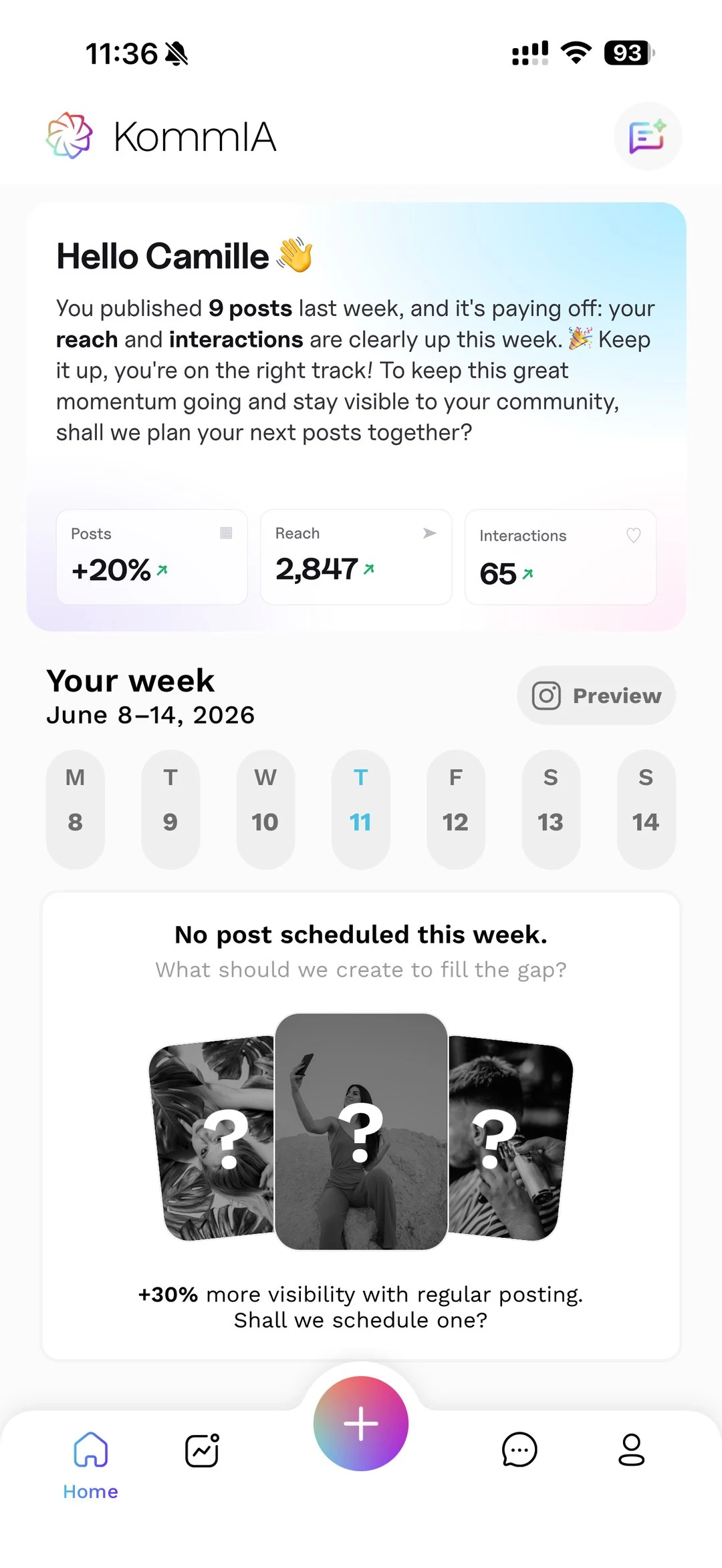
This is where KommIA's scheduling features make a real difference. KommIA publishes your posts automatically, so a photo you shoot during afternoon prep goes live later, at the time you picked, without you having to remember or open the app again. You batch your content when you have a quiet moment, and the platform handles the timing. That alone removes the main reason most small restaurants go silent on Instagram for weeks at a time.
You can take a look at KommIA's pricing to see whether it fits a small operation. The goal is to spend less time managing the tool and more time in your dining room.
A Few Quick Algorithm Points for 2026
Instagram does not use a single algorithm. The Feed, Reels, and Stories are each ranked separately, so what works in one surface does not automatically transfer to another. Post natively: avoid reposting content from another platform as is, especially a TikTok video with its watermark. Content made for Instagram, in its format, is the better bet.
Instagram does not cut your reach just because you use AI: since 31 August 2026, only a profile that shows an AI-generated person without saying so loses its recommendations. Using a tool to help write or plan is fine, and smart. But your personality, your food, your space: those have to come through. Nobody books a table because of a generic caption.
The practical upshot is simple. Film your food, show your team, talk to your followers in Stories, repost what your guests share, and let a tool like KommIA handle the scheduling so nothing slips when the kitchen is full.