
Hello. If you run a small business, work as a freelancer, or craft things with your hands, Instagram Stories are probably one of the fastest ways to stay in front of your audience without spending hours on content. Story replies grew 88% in a year, according to Metricool (June 2026). That means your followers are already there, already reacting. You just need to give them something worth tapping through.
Why Stories deserve more of your attention
Stories sit at the very top of the app: they are the first thing your followers see when they open Instagram. When a sequence is well built, people happily watch it to the end. And showing up regularly in Stories keeps the connection with your community alive between two posts.
That creates a positive loop: good Stories today keep your community close tomorrow. One more thing worth knowing is that a Story announcing your new feed post or Reel tells your audience it is live and gives them direct access to it the moment you publish.
The structure that keeps people watching
Before getting into specific ideas, a quick note on structure. A Story sequence that works tends to follow this pattern: the first slide hooks the viewer with a clear promise, slides two through four develop the idea and include interactive stickers, and the last slide ends with a single call to action. This mirrors the way people tap through Stories and helps keep your completion rate high.
Also, if your opening slide does not grab attention immediately, the rest of the sequence will never be seen. So make it direct, visual, and interesting from the very first second.
15 story ideas that actually work
- Poll on a professional choice: Ask your audience to pick between two options, like two versions of a product, two service names, or two color palettes. A poll gives people a reason to respond, and so to stop on your Story.
- Quick Q&A session: Open a question box and answer the best questions the same day. This sends replies to your DMs, which opens a private conversation, often the first step toward a sale.
- “This or that” game: Show two contrasting options and ask people to vote. It is low effort to produce and generates consistent responses.
- Behind the scenes: Show your workspace, a work in progress, or your morning routine. People follow small businesses partly because they want to see the human side.
- Spontaneous client review: Screenshot a genuine message or review (with permission) and share it. Social proof in Stories converts better than a polished graphic in the feed.
- Countdown to a limited offer: Use the countdown sticker on a sale, a product launch, or a booking window. The urgency is real and it keeps people coming back.
- “3 spots left” availability post: If you are a freelancer or service provider, a simple slide saying “3 sessions available this week, link in story” with the link sticker drives direct bookings.
- Quiz about your craft or trade: Ask a question about your process, your materials, or your field. It teaches your audience something while generating taps and replies.
- Day in the life: A short sequence of 3 to 5 slides showing what your actual working day looks like. No need for perfection, real is better here.
- Before and after: Two slides. The result speaks for itself. Works for photographers, decorators, bakers, tailors, coaches, and many more.
- Teaser for an upcoming post or Reel: A quick slide saying “new post dropping at 6pm” builds anticipation and tells your audience where to look when it goes live.
- Product or service spotlight: One slide per feature or benefit, ending with a link sticker. Simple, informative, and easy to produce in batches.
- Personal opinion or take: Share a view on something in your industry. It starts conversations and positions you as someone with a point of view, not just a catalog.
- Geolocation tag (for physical locations): If you have a shop, studio, or market stall, always add the location sticker. It makes your content discoverable to local people who do not yet follow you.
- Repurposed tip from a past post: Take one insight from an older post and turn it into a two-slide Story. You already made the content, now make it work harder.
How to keep up the rhythm without it taking over your day
No recent official source sets an ideal number of Stories per day: a regular rhythm, even a modest one, is enough, and you can post more when you have material. The key is that quality matters more than volume.
Batching is your best friend here. Set aside a slot each week to create a week's worth of Story content, then schedule everything at once. To pick your times, check your Instagram insights to see when your audience is most active, and post your Stories just before those peaks.
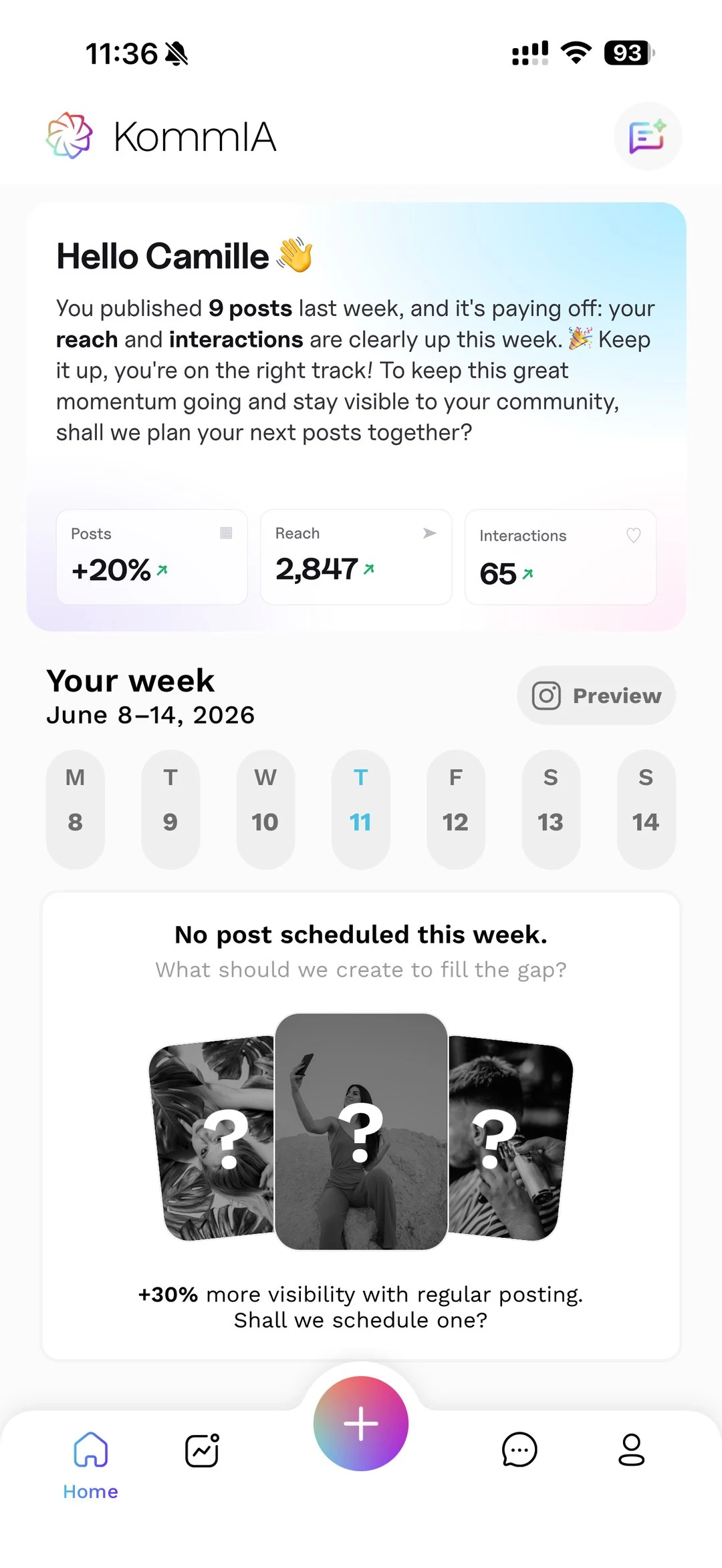
That is exactly where KommIA saves you real time. It suggests three time slots based on your account's activity for your Stories and posts, so you do not have to work it out each day. KommIA suggests the story ideas, you shoot them in one sitting, and KommIA publishes them at the time you pick, several in a row if you want. Check the pricing page to see whether the monthly or the annual plan fits your business. Rather than posting manually every afternoon, you can focus on the work that actually pays.
The metrics that tell you what is working
Do not just look at views. The numbers that actually matter are your completion rate (the higher the better), your exit rate per slide (the lower the better), and the ratio of taps forward to taps back. If people are rewinding, that is a good sign. If they are exiting on a specific slide, something is not landing there.
Stories analytics also show you sticker interactions, DM replies, and link taps. These behavioral signals tell you far more than view counts about what your audience actually does with your Stories.